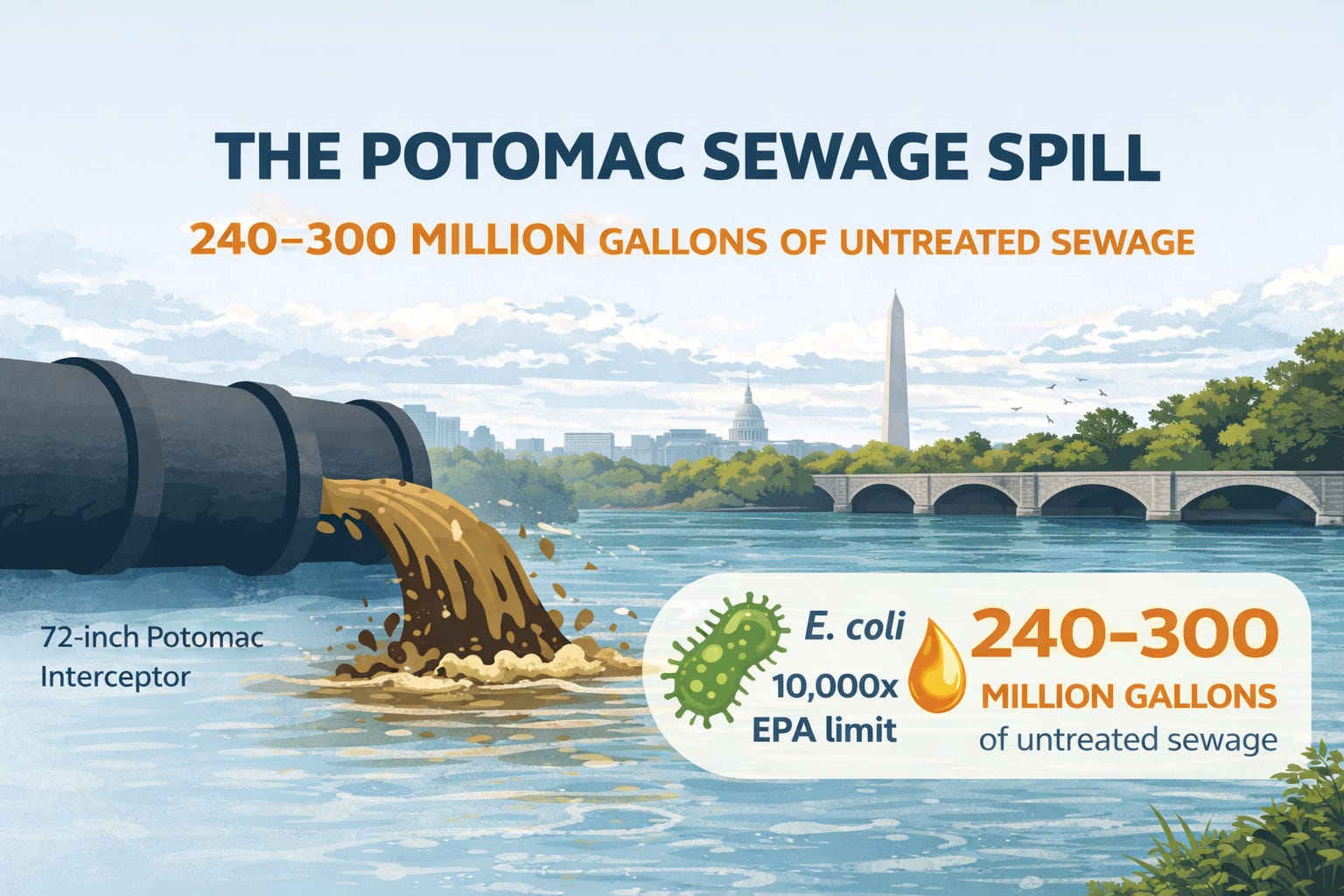
On the afternoon of January 19, a six-foot-wide sewer main collapsed beneath the Clara Barton Parkway in Montgomery County, Maryland. Over the next three weeks, somewhere between 240 and 300 million gallons of raw, untreated sewage poured straight into the Potomac River.
That is a staggering amount of waste. It’s comparable in volume to the 2010 Deepwater Horizon oil spill. Environmental advocates and researchers have described it as one of the largest sewage spills in American history. And it happened in the river that runs through the nation’s capital.
The pipe that failed is called the Potomac Interceptor. Most people in the D.C. metro area have never heard of it. Built in 1962, it carries wastewater from suburbs around Dulles International Airport and parts of Montgomery County down to the Blue Plains treatment plant in southeast Washington. It worked fine for sixty-four years. Then it didn’t.
The Damage
When researchers from the Potomac Riverkeeper Network and the University of Maryland tested the water after the collapse, E. coli levels near the spill site came back at 10,000 times the EPA’s recreational safety limit. That number has come down since, but as of late February, the river is still not safe for swimming or fishing along the affected stretch.
And bacteria is only part of the problem. Raw sewage carries pharmaceuticals, household chemicals, and all kinds of stuff people pour down drains that you don’t want settling into riverbed sediment. That material can mess with fish and bird reproduction, kill aquatic insects, and contaminate the soil along the banks. Environmental scientists are warning that the worst might still be ahead. As temperatures warm this spring, dormant bacteria will reactivate, and the conditions could trigger algae blooms bad enough to kill fish up and down the river.
Montgomery, Prince George’s, and Charles counties in Maryland have all issued health advisories telling residents to stay out of the river. Virginia’s Department of Health put out its own recreational advisory on February 13. If you paddle, fish, or boat on the Potomac, there’s no clear timeline for when you’ll be able to again.
The Fix, and Its Limits
DC Water crews finished a bypass on January 24, rerouting most of the wastewater around the collapsed section. But intermittent overflows kept happening during high-flow events until February 8, when the discharge finally stopped.
The actual repair has been harder than anyone expected. Workers found a massive pile of boulders and rocks jammed inside the ruptured pipe, basically a rock dam that has to be excavated out with heavy machinery and specialized equipment before permanent fixes can even begin.
Emergency repairs are expected by mid-March. The longer-term rehabilitation of a 2,700-foot section of the interceptor will use sliplining and geopolymer reinforcement, and DC Water estimates that work will take nine to ten months. The combined tab for repair and environmental remediation has already hit $20 million.
Here’s the part that stings: DC Water had already started rehabilitation work on the interceptor months before the collapse. The pipe failed anyway.
Washington Responds
On February 18, D.C. Mayor Muriel Bowser declared a public emergency and asked for federal help. The next day, President Trump directed the EPA to lead the response, with FEMA and the Army Corps of Engineers backing them up. FEMA agreed to cover 75 percent of eligible costs.
EPA Administrator Lee Zeldin, in an appearance on Fox Business last week, put it simply: “Cleanup is going to take a while.”
The one bit of good news in all of this is that D.C.’s drinking water was never at risk. The city pulls its water from the Potomac upstream of the spill, and so does Fairfax Water, which serves much of Northern Virginia. Maryland officials confirmed the same for their state intakes. Everyone’s tap water is fine.
This Isn’t Just a D.C. Problem
The Potomac spill is dramatic, but it’s not some freak accident. Aging sewer infrastructure is a slow-moving crisis across the entire country. The American Society of Civil Engineers’ 2025 Report Card gave U.S. wastewater systems a near-failing grade and found that the rate at which utilities replace aging pipes has actually gone down over the past decade, even as failures have become more frequent.
A lot of American cities still run combined sewer systems, designed more than a century ago, that handle both wastewater and stormwater in the same pipes. When it rains hard, those systems overflow and dump untreated sewage into rivers. Climate change is making that worse.
The Potomac Interceptor wasn’t a combined system. But it shared the same basic vulnerability: old infrastructure carrying more than it was designed for, in a region that has grown enormously since the pipe went into the ground in 1962.
What Comes Next
DC Water and federal agencies are focused on getting the pipe fixed. The environmental recovery is a much longer story. The D.C. Department of Energy and Environment has announced fish and wildlife surveys starting this spring to try to get a handle on the ecological damage. Researchers will be watching the water temperatures, looking for algae blooms, tracking how the contaminants that settled into the sediment move through the system.
For the people who live along the Potomac, the questions are simpler. When can I take my kayak out? When can my kids play in the water? When will the fish be safe to eat?
Nobody has good answers yet. The river is still recovering, and the pipe that failed it is still being put back together.
Sources: NPR, NBC News, Bloomberg, Potomac Conservancy, Bethesda Magazine, Engineering News-Record, Washingtonian, Johns Hopkins Bloomberg School of Public Health
This article was originally published on our Substack newsletter. Subscribe to get new posts delivered to your inbox.

Licensed Real Estate Agent · The Feldman Group at RLAH@properties
Serving Montgomery County, MD — including Potomac, Bethesda, Rockville, and beyond. Get in touch · 301-564-3058