This wasn’t what I was planning to write about this week, but it’s worth your attention.
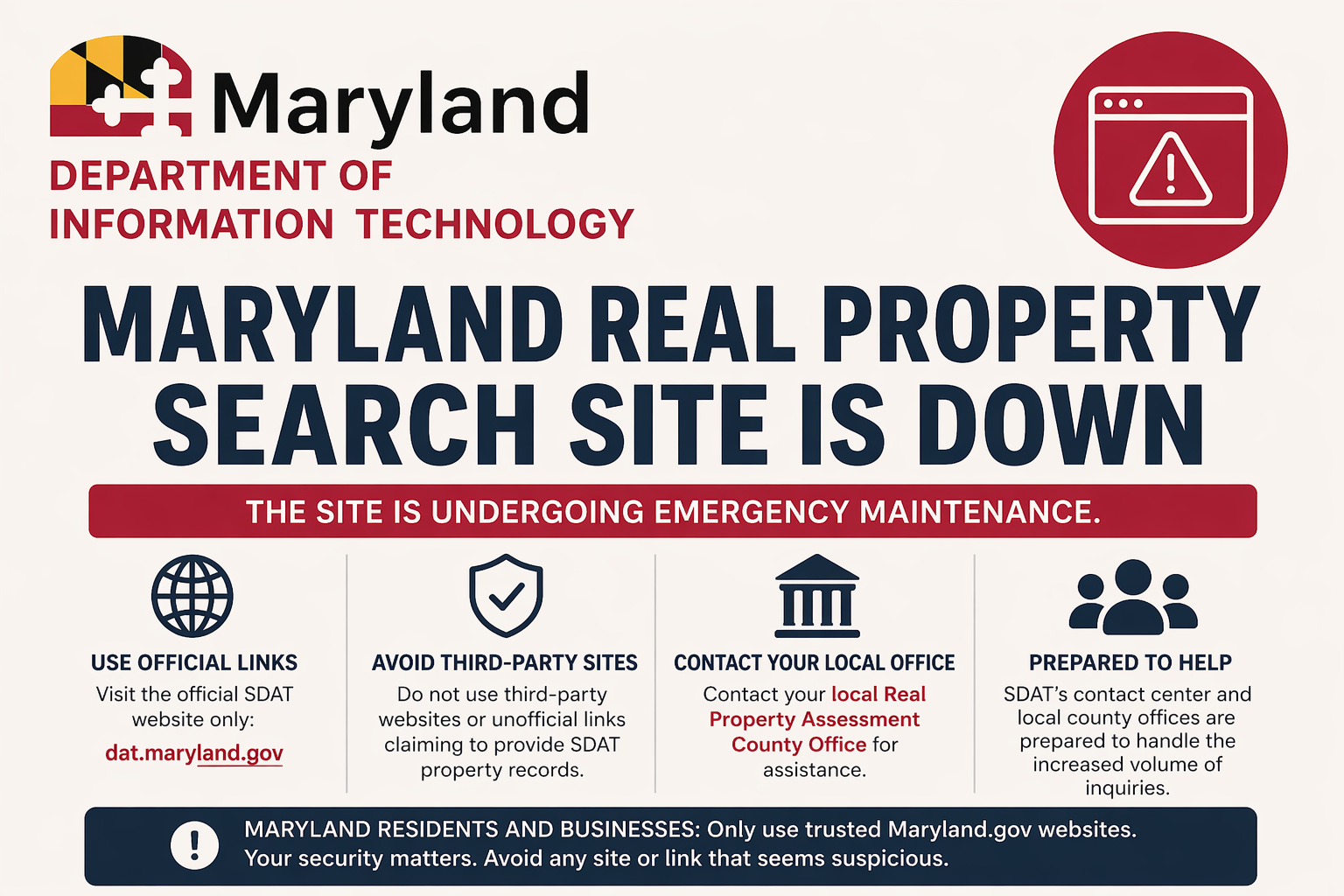
If you’ve tried to pull up a Maryland property record since Tuesday, April 14, you’ve already run into this. The State Department of Assessments and Taxation’s Real Property Search tool is offline. That’s the database many of us use every day for ownership, assessment, and sales history, and the one homeowners often use to check their own property record. State officials detected “suspicious activity” on the servers that support the site, took it down as a precaution, and as of the latest reporting, it’s still dark.
The Maryland Department of Information Technology (DoIT) is running the investigation alongside SDAT. Their early read, for what it’s worth, is reassuring. DoIT says its analysis suggests the affected systems contained only public information already available through the site, and it does not anticipate a broader cybersecurity risk to the state at this time. The site is staying offline until the system is cleared for public use.
That’s the news. Now let’s talk about what it actually means for you as a homeowner, a buyer, a seller, or just someone who’d prefer not to find out someone else has been playing games with your deed.
What’s actually broken right now
The Real Property Search tool is the public-facing front door for Maryland property data: ownership, assessed value, and sales history. It’s what Realtors pull before a listing appointment, and what homeowners use to double-check their assessment before filing an appeal. For recorded deeds and the controlling land records, Maryland Land Records (mdlandrec.net) and the circuit court clerks are the systems that matter most, and those are still up.
With the search tool down, a few things are slower than usual:
Casual property lookups. If you wanted to peek at a neighbor’s sale price or your own tax record, you’re out of luck until the system is restored.
Listing prep. My team has workarounds. Tax records are still being pulled through MLS and county-level sources. Anything that normally takes 30 seconds is taking a few minutes more.
FSBO and investor due diligence. Folks outside the MLS ecosystem feel this most. If that’s you, SDAT is directing people to their local Real Property Assessment County Office. In Montgomery County, that’s 30 W. Gude Drive, Suite 400, Rockville, (240) 314-4510. Other counties have their own locations listed on the SDAT site.
The good news: closings are not grinding to a halt. Title companies work primarily off the Clerk of the Circuit Court’s land records, which are a different system and are still running. If you’re mid-transaction, ask your title company directly. In nearly every case I’ve heard about this week, things are moving.
The part I care more about: what this moment is telling us
Here’s the uncomfortable backdrop. Even before this outage, property records have become a favorite hunting ground for fraudsters. The FBI’s 2024 IC3 report logged 9,359 real estate fraud complaints and about $173.6 million in losses, though that category includes more than deed fraud alone (investment, rental, and timeshare scams are folded in). NAR’s 2025 Deed & Title Fraud Survey found that 62% of reported title-fraud cases involved vacant land, while only 12% involved owner-occupied homes. Empty lots are the soft target, but owner-occupied is far from zero.
In Annapolis, lawmakers have already moved. HB 130 has passed the General Assembly and is now enrolled. The enrolled bill does three things at once: it creates new criminal penalties for a range of deed-fraud conduct (fraudulent sale, conveyance, or leasing of property you don’t own, acquisition of property by deception or intimidation, and possession of a counterfeit deed, with the core offense carrying up to 10 years and a $7,500 fine as a felony), establishes a Deed Fraud Prevention Grant Fund, and sets up a Task Force to Study Deed Fraud with findings due to the General Assembly by July 1, 2028. The effective date is October 1, 2026. It’s a clear signal the state knows this is no longer a fringe issue.
The SDAT outage isn’t, from what we know so far, a deed-fraud event. But it is a useful prompt. When was the last time you actually looked at the public record for your own home?
Five things to do this week
Whether the Real Property Search is up or down, these are worth doing.
1. Check your deed the moment the system is back online. Pull your own property, verify the owner name, and glance at the recorded history. If anything looks off, call your title attorney immediately. Not next week.
2. Bookmark mdlandrec.net and check your own record. Before paying for any private monitoring product, don’t assume your county already offers a free alert system, and know that monitoring services do not stop a fraudulent filing from being recorded in the first place. They notify you after the fact. Montgomery County’s Office of Consumer Protection has warned homeowners about overstated claims from paid “home title lock” products advertised on the radio. My recommendation: bookmark Maryland Land Records at mdlandrec.net, pull your own property once a quarter, and scan for anything you didn’t authorize.
3. Don’t use third-party “property records” sites during the outage. The state specifically warned about this, and for good reason. Scam sites pop up quickly around moments like this, and some of them are designed to harvest personal data or push you toward phishing pages. If you need data now, call or visit the Assessment County Office directly.
4. Tighten up the basics. Strong, unique passwords on your email, especially the email tied to your mortgage, title insurance, and bank. Multi-factor authentication on everything. Be extra skeptical of any email claiming to be from SDAT or “Maryland Property Records” this week. That’s exactly when phishers take their shot.
5. Know who to call. If you think you’ve been the target of deed fraud, your first three calls are: (1) your title insurance company, assuming you have an owner’s policy (and if you don’t, let’s talk about why you should), (2) a Maryland real estate attorney, and (3) the local Clerk of the Circuit Court where the suspect document was recorded.
What I’ll be watching
Two things I’ll update you on as this unfolds. First, when SDAT brings the Real Property Search back, I’ll send a quick note, and I’d encourage you to pull your own record that day. Second, I’m tracking HB 130 from enrolled bill to final enactment. If it becomes law as enrolled, Maryland will have stronger criminal and enforcement tools behind deed-fraud cases starting October 1, 2026.
This is the kind of story that fades from the news in about a week but quietly reshapes how we all ought to be thinking about our homes. They’re assets to protect, not just places to live.
As always, if you have a question about your specific property, your title, or anything that pops up while the system’s down, hit reply. That’s what I’m here for.
Talk soon,
Corey
The Feldman Group | feldmangroupre.com
Sources: The MoCo Show, Baltimore Sun, Eye On Annapolis, Maryland General Assembly HB0130, Maryland Land Records, Montgomery County OCP on “Home Title Fraud” monitoring, NAR 2025 Deed & Title Fraud Survey, FBI IC3 2024 Report.
This article was originally published on our Substack newsletter. Subscribe to get new posts delivered to your inbox.

Licensed Real Estate Agent · The Feldman Group at RLAH@properties
Serving Montgomery County, MD — including Potomac, Bethesda, Rockville, and beyond. Get in touch · 301-564-3058
You May Also Enjoy
What’s Your Neighborhood Really Worth? Now You Can See It.
If you own a home in Potomac, Bethesda, or Rockville, or you’re trying to buy in one of those ...
Just Listed in Fox Hills West: 12721 Lincolnshire Dr Potomac, MD 20854
Open Houses: Saturday, April 11 | 1:00 PM – 4:00 PM Sunday, April 12 | 1:00 PM – 4:00 PM...
Coming Soon in Fox Hills West, Potomac 🏡
Open Houses: → Saturday, April 11 | 1:00 PM – 4:00 PM & → Sunday, April 12 | 1:00 ...